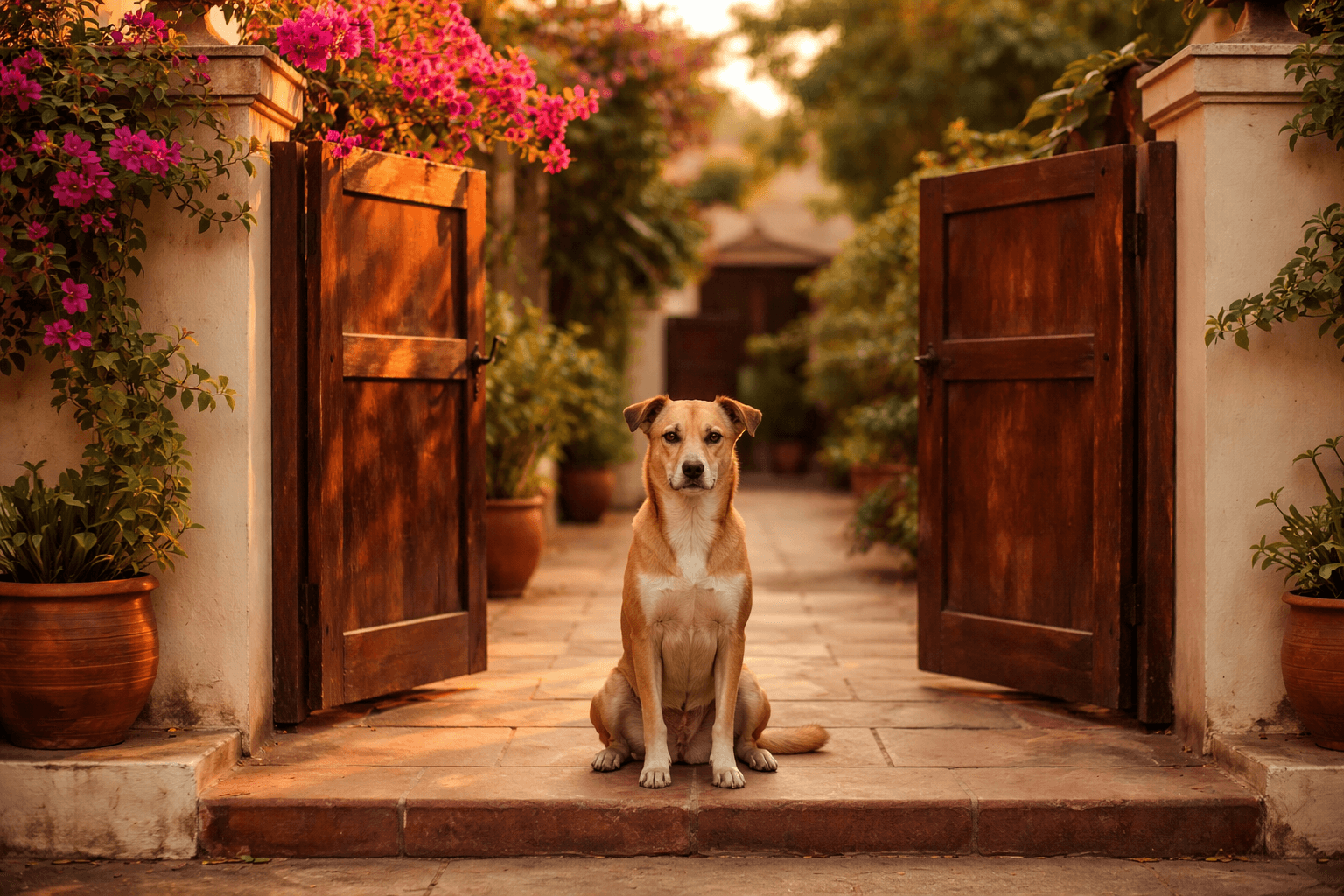
A family in a tier-2 town in Gujarat told us about Pinto — a young indie who spent eleven evenings outside their gate before they let him in. They didn’t notice him on the first evening. Or maybe they did — the way you notice a passing shadow, something that doesn’t yet belong to your story. He sat near the wooden gate, not too close, not begging. Just there. Watching. Waiting, but not asking. By the second evening, someone in the house pointed him out. “Woh kal bhi tha na?” He was. Same spot. Same quiet stillness. As if he had decided something, and the family just hadn’t caught up yet. They tried to ignore him at first. In towns like theirs, dogs come and go. Some stay for a day, some for a week. You don’t assume permanence. You don’t assume attachment. But Pinto wasn’t passing through. On the fourth evening, he shifted slightly closer to the gate. Not inside. Not intruding. Just… closer. His eyes followed the rhythm of the home — who came in, who stepped out, when the lights turned on. He wasn’t watching for food. He was learning the house. By the sixth evening, the youngest member of the family began leaving a small bowl of water outside. No one announced it. No one made a decision. It just happened — the way small kindnesses often do, quietly and without permission. Pinto drank, but he didn’t wag wildly. No performance. No sudden affection. He remained composed, almost as if he knew that belonging isn’t built in a moment — it’s built in repetition. Evenings passed like this. Seven. Eight. Nine. By now, the family had started expecting him. Someone would glance at the gate around the same time, almost subconsciously. And there he would be — already present, as if he had arrived before the thought of him did. On the tenth evening, it rained. Not heavily, but enough to send most street dogs searching for shelter. The family assumed he wouldn’t come. It felt unreasonable to expect that kind of persistence. But when they checked, he was there. Wet. Quiet. Unmoving. Not scratching at the gate. Not crying. Just sitting in the rain, as though the weather was irrelevant to whatever decision he had made. That evening changed something. It wasn’t pity. It wasn’t even kindness. It was recognition. “He’s not waiting for food,” someone said. “He’s waiting for us.” On the eleventh evening, they opened the gate. Not wide. Not ceremoniously. Just enough. Pinto didn’t rush in. He stepped forward slowly, paused at the threshold, and looked back once — at the street, at whatever life he had known before. And then he crossed over. No chaos. No excitement. Just a quiet arrival. Inside, he didn’t explore like a guest. He didn’t hesitate like a stranger. He moved like someone who had already decided this was home — long before the door was opened. That’s the part that stayed with them. They didn’t adopt Pinto in a moment of emotion. Pinto adopted them — one evening at a time. There’s something deeply human in how we think about belonging. We assume it needs permission, timing, certainty. But sometimes, it’s much simpler. Sometimes, it’s a presence that returns. Again and again. Without demand. Without urgency. Until it becomes undeniable. Pinto didn’t bark for entry. He didn’t plead for attention. He chose the doorstep — and stayed with that choice long enough for the family to see it. And maybe that’s what guardians do. They don’t always stand at the door to protect what’s inside. Sometimes, they sit outside — protecting a possibility. Waiting for the moment it becomes real.
Stories
The dog who chose the doorstep
A family in a tier-2 town in Gujarat told us about Pinto — a young indie who spent eleven evenings outside their gate before they let him in.